Showing posts with label Nebula. Show all posts

Friday, March 29, 2013

NGC 7635


I started this photograph last year at the Peach State Star Gaze that was held at the Deerlick Astronomy Village.  It is a wonderful place to camp and look up at the stars.  This photograph is of NGC 7635, SH2-162, also called the Bubble Nebula.  It is an emission nebula about 7,800 light years away in the constellation Cassiopeia.   The estimated width across the bubble is 10 light years.  Total exposure time 21.5 hours.  Hope you enjoy!

Saturday, December 29, 2012

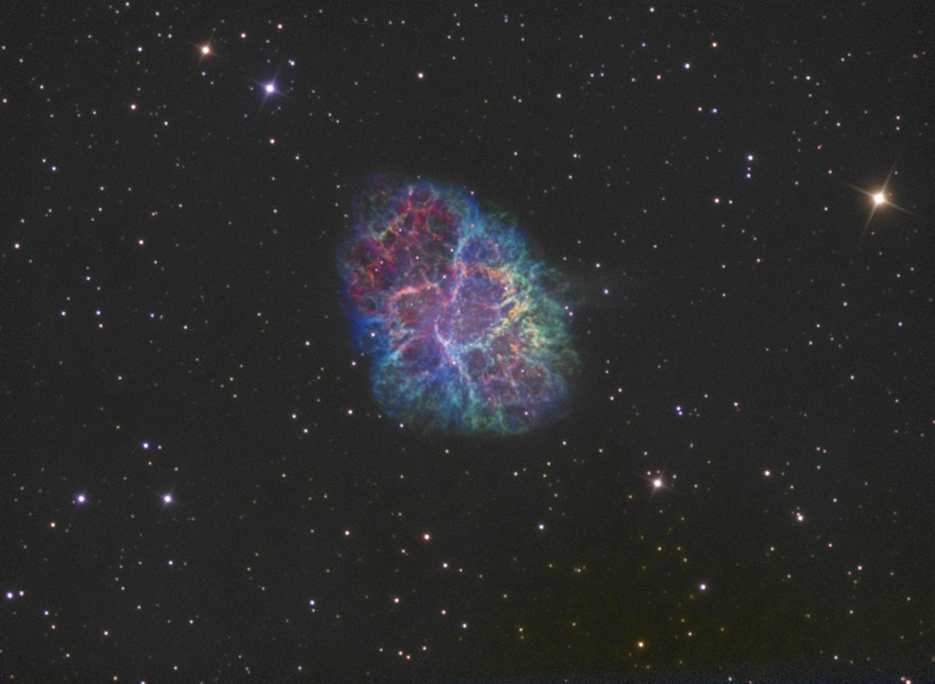
M1 Crab Nebula


The Crab Nebula is a supernova remnant in the constellation of Taurus. The nebula was observed by John Bevis in 1731; it corresponds to a bright supernova recorded by Arab, Chinese and Japanese astronomers in 1054. Total of 18.5 hour exposure taken through emission line filters.

Saturday, November 24, 2012

IC434


Optics:  Deep Sky Instruments RC10C
Mount:  Astro-Physics AP900GTO
Camera:   SBIG ST2K XM
Guiding Camera:  SBIG ST-i
Filters Astrodon  S2, Ha & O3
Location:  Deerlick Astronomy Village & Roswell Georgia

Exposure Details
S2 = 660 Minutes (mapped to red)
Ha = 405 Minutes (mapped to green)
O3 = 210 Minutes (mapped to blue)
All sub-exposures were 15 Minutes.

Wednesday, September 26, 2012

NGC7000


After raking the fall leaves as a small boy I use to spend time daydreaming and looking at the clouds - forming familiar shapes of animals and objects - usually from the books that I was reading or from places we visited.  The same way I use to daydream as a child – I find myself “night” dreaming while at the telescope.  This one reminds me of a palm tree bending in the oceans breezes.  As an “older” boy now it is nice to remember those younger days. 

This photograph is a small 22 x 30 arc minute view of the North America Nebula.  NGC7000 is a  emission nebula located in the constellation Cygnus close to the star Deneb and about 1800 light years distance.   This dim nebula is quite large covering an area larger than four full moons and was discovered by William Herschell on October 24, 1786.  


Optics:  Deep Sky Instruments RC10C
Mount:  Astro-Physics AP900GTO
Camera:   SBIG ST2K XM
Guiding Camera:  SBIG ST-i
Filters Astrodon  S2, Ha & O3
Location:  Deerlick Astronomy Village & Roswell, Georgia

Two Part Mosaic Total Exposure Details
S2 = 1440 Minutes (mapped to red)
Ha = 300 Minutes (mapped to green)
O3 = 1050 Minutes (mapped to blue)
All sub-exposures were 15 Minutes.
Total Exposure Time 46.5 Hours

Tuesday, August 14, 2012

NGC 6888


It was wonderful to see the stars the last few nights. The air was calm, cool with low humidity, the skies steady – perfect weather for imaging!

The Crescent Nebula (also known as NGC 6888, Caldwell 27, Sharpless 105) is an emission nebula in the constellation Cygnus, about 5000 light years away from our home planet. .

Optics:  Deep Sky Instruments RC10C
Mount:  Astro-Physics AP900GTO
Camera:   SBIG ST2K XM
Guiding Camera:  SBIG ST-i
Filters Astrodon  Ha and O3
Location:  Roswell, Georgia

Exposure Details:
Ha = 330 Minutes (mapped to red)
O3 = 480 Minutes (mapped to blue & green)

Thursday, July 5, 2012

NGC6992


The eastern portion (NGC 6992) of the Veil Nebula is a cloud of heated and ionized gas and dust in the constellation Cygnus.  This four picture mosaic only represents a small portion of this wonderful area of the sky.
Optics:  Deep Sky Instruments RC10C
Mount:  Astro-Physics AP900GTO
Camera:   SBIG ST2K XM
Guiding Camera:  SBIG ST-i
Filters Astrodon  Ha and O3
Location:  Roswell, Georgia

Exposure Details:
Four part mosaic - Total exposure time of 27.5hrs
Ha = (mapped to red)
O3 = (mapped to blue & green)

Wednesday, April 25, 2012

M16


Lots of wind and cold weather at DAV this weekend, but I was finally able to get enough data to finish M16.

Young star cluster M16 is surrounded by clouds of cosmic dust and glowing gas also known as The Eagle Nebula.  The Eagle Nebula is part of a diffuse emission nebula, or H II region, which is catalogued as IC 4703. This region of active current star formation is about 6,500 light-years distant in the Constellation Serpens.

Optics:  Deep Sky Instruments RC10C
Mount:  Astro-Physics AP900GTO
Camera:   SBIG ST2K XM
Guiding Camera:  SBIG ST-i
Filters Astrodon  S2, Ha & O3
Location:  Deerlick Astronomy Village

Exposure Details
S2 = 240 Minutes (mapped to red)
Ha = 195 Minutes (mapped to green)
O3 = 165 Minutes (mapped to blue)
All sub-exposures were 15 Minutes.

Friday, April 20, 2012

NGC2237


Radiation from young stars in NGC2237 makes the nebula shine by exciting its atoms to emit radiation. The dark nebula, consisting of cooler gases and dust, is highlighted against this glowing background.  This picture is a small 22’x16’ arc minute view of a portion of the Rosette Nebula located 5,200 light years away from our home in the Constellation Monoceros. 

Optics:  Deep Sky Instruments RC10C
Mount:  Astro-Physics AP900GTO
Camera:   SBIG ST2K XM
Guiding Camera:  SBIG ST-i
Filters Astrodon  S2, Ha & O3
Location:  Roswell, Georgia

Exposure Details
S2 = 345 Minutes (mapped to red)
Ha = 180 Minutes (mapped to green)
O3 = 180 Minutes (mapped to blue)
All sub-exposures were 15 Minutes.

Thursday, April 12, 2012

M76


The Little Dumbbell Nebula, also known as Messier 76, is a planetary nebula located 2,500 light years away in the constellation Perseus.

Optics:  Deep Sky Instruments RC10C
Mount:  Astro-Physics AP900GTO
Camera:   SBIG ST2K XM
Guiding Camera:  SBIG ST-i
Filters Astrodon  Ha, O3, Red, Green and Blue
Location:  Roswell, Georgia

Exposure Details
Ha = 510 Minutes (mapped to green)
O3 = 360 Minutes (mapped to blue)
RGB = 30 Minutes for Star Color

Monday, March 5, 2012

IC443


IC443 is a super nova remnant located about 5,000 light years away in the constellation Gemini. 

Optics:  Deep Sky Instruments RC10C
Mount:  Astro-Physics AP900GTO
Camera:   SBIG ST2K XM
Guiding Camera:  SBIG ST-i
Filters Astrodon  S2, Ha & O3
Location:  Roswell, Georgia

Exposure Details
S2 = 240 Minutes (mapped to red)
Ha = 345 Minutes (mapped to green)
O3 = 360 Minutes (mapped to blue)
All sub-exposures were 15 Minutes.

Thursday, February 2, 2012

SH2-252


SH2-252 is an emission nebula located about 6,350 light years away in the constellation Orion. 

Optics:  Deep Sky Instruments RC10C
Mount:  Astro-Physics AP900GTO
Camera:   SBIG ST2K XM
Guiding Camera:  SBIG ST-i
Filters Astrodon  S2, Ha & O3
Location:  Roswell, Georgia

Exposure Details
S2 = 420 Minutes (mapped to red)
Ha = 270 Minutes (mapped to green)
O3 = 255 Minutes (mapped to blue)
All sub-exposures were 15 Minutes.

Sunday, January 29, 2012

M97


M97 also known as the “Owl Nebula” is a planetary nebula located in the constellation Ursa Major.  


Optics:  Deep Sky Instruments RC10C
Mount:  Astro-Physics AP900GTO
Camera:   SBIG ST2K XM
Guiding Camera:  SBIG ST-i
Filters Astrodon  Ha & O3
Location:  Roswell, Georgia

Exposure Details
Ha = 240 Minutes (mapped to red)
O3 = 195 Minutes (mapped to blue and green)

Friday, December 30, 2011

IC 1848


This photo is a small part of the IC 1848 emission nebula located in Cassiopeia.  This image so reminds me of the “Time Portal” from Star Trek series “The City on the Edge of Forever”.

Optics:  Deep Sky Instruments RC10C
Mount:  Astro-Physics AP900GTO
Camera:   SBIG ST2K XM
Guiding Camera:  SBIG ST-i
Filters Astrodon  S2, Ha & O3
Location:  Roswell, Georgia

Exposure Details
S2 = 540 Minutes (mapped to red)
Ha = 480 Minutes (mapped to green)
O3 = 450 Minutes (mapped to blue)

Monday, December 19, 2011

M42


M42 is located approximately 1350 light years from our home in the constellation Orion.  This photo is a small portion of the dim outer arm of this nebula.  The imaged was processed to accent the wispy almost smoke like features of this region.  Hope that you enjoy.

Optics:  Deep Sky Instruments RC10C
Mount:  Astro-Physics AP900GTO
Camera:   SBIG ST2K XM
Guiding Camera:  SBIG ST-i
Filters Astrodon  Ha & O3
Location:  Roswell, Georgia

Exposure Details
Ha = 375 Minutes (mapped to red)
O3 = 375 Minutes (mapped to both blue and green)

Wednesday, November 16, 2011

M27


M27, the Dumbell Nebula, is a beautiful planetary nebula located in the constellation Vulpecula.

Optics:  Deep Sky Instruments RC10C
Mount:  Astro-Physics AP900GTO
Camera:   SBIG ST2K XM
Guiding Camera:  SBIG ST-i
Filters Astrodon  Ha & O3
Location:  Roswell, Georgia

Exposure Details
Ha = 300 Minutes
O3 = 300 Minutes

Monday, June 27, 2011

IC4603

Optics: Takahashi FSQ-106
Mount: Astro-Physics AP900GTO
Camera: SBIG ST2K XM
Filters Astrodon L, R, G, & B
Dates: April 12, 2010 through May 9, 2011
Location: Deerlick Astronomy Village

Exposure Details
L = 120 Minutes
RGB = 360 Minutes

Tuesday, November 23, 2010

NGC 2264, SH2-273

Located about 2,600 light-years away in the constellation Monoceros, this 16+ hour photograph of NGC 2264 is sometimes referred to as the Christmas Tree cluster.

Optics: Takahashi FSQ-106
Mount: Astro-Physics AP900GTO
Camera: SBIG ST2K XM
Filters Astrodon L, R, G, B & Ha
Dates: October 6, 2008 through November 10, 2010
Location: Roswell, Georgia and Deerlick Astronomy Village

Exposure Details
Ha = 360 Minutes
L = 285 Minutes
RGB = 370 Minutes

Tuesday, October 19, 2010

VDB152

Optics: Takahashi FSQ-106
Mount: Astro-Physics AP900GTO
Camera: SBIG ST2K XM
Filters Astrodon Luminance, Red, Green and Blue
Dates: October 4, 2010 through October 11, 2010
Location: Deerlick Astronomy Village
Exposure Details
L = 510 Minutes
RGB = 620 Minutes

Wednesday, October 13, 2010

NGC1499, SH2-220


Optics: Takahashi FSQ-106
Mount: Astro-Physics AP900GTO
Camera: SBIG ST2K XM
Filters Astrodon S2, Ha & O3
Dates: November 11 2008 through October 11, 2010
Location: Roswell, Georgia and Deerlick Astronomy Village

Exposure Details
S2 = 375 Minutes
Ha = 360 Minutes
O3 = 210 Minutes

Tuesday, September 7, 2010

NGC896


Optics: Takahashi FSQ-106
Mount: Astro-Physics AP900GTO
Camera: SBIG ST2K XM
Filters Astrodon S2, Ha & O3
Dates: August 10 2009 through September 7, 2010
Location: Roswell, Georgia

Exposure Details
S2 = 795 Minutes
Ha = 720 Minutes
O3 = 735 Minutes